
Investigations and Reports
RITE is looking into systemic failures that impact democracy and the rule of law in both international relations and domestically.
2025/26
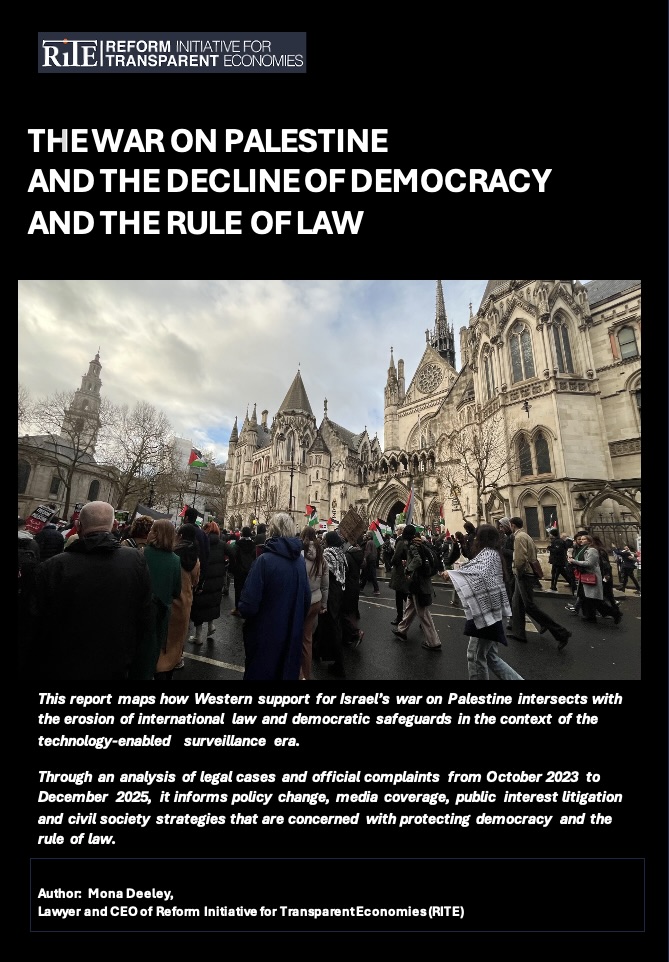
Key Findings
1. ALLIES REWARDED ISRAEL FOR BREAKING INTERNATIONAL LAW AND PUNISHED JUDGES AND UN OFFICIALS FOR FULFILLING THEIR DUTY
Despite the ICJ’s 2024 Opinions, the US, Europe and other allies did not act to prevent genocide and occupation, restricted funding to UN aid, and maintained or increased military assistance, arms transfers and trade. When the ICC issued arrest warrants for Israeli Prime Minister Netanyahu and Defence Minister Gallant, the US sanctioned the judges and certain European countries were ambivalent about compliance and attacked UN officers that are warning against complicity. Legal challenges in the US, UK, Germany and the Netherlands have exposed inadequate risk assessments for arms sales, with limited mechanisms for review or accountability. It was left to civil society to pursue war criminals and companies complicit in genocide or occupation in domestic and international jurisdictions.
2. DOMESTIC COURTS HAVE UPHELD CIVIL RIGHTS AND GOVERNMENTS HAVE IGNORED THEIR RULINGS
Litigation across the US, UK and Germany reveals a systematic pattern: discrimination, dismissals, doxing, surveillance, arrests, defunding threats, and misuse of counterterrorism and immigration powers. This is against a wide range of ordinary citizens such as workers, students, academics, journalists, artists, sports people, UN staff, doctors, the elderly and the disabled. Courts have ruled that criticism of Israel and Zionism, engaging in boycotts and divestments, and holding conferences and public gatherings are all protected under law. Governments and institutions have not changed their policies to align with the position at law as is their duty to do.
3. TECHNOLOGIES THAT ARE AIDING WAR CRIMES, OCCUPATION AND DISINFORMATION ARE BEING USED DOMESTICALLY
The report documents how technology companies have gone from regularly breaching data, privacy and copyright protections to developing surveillance infrastructures that draw on data-driven technologies. Everyday applications such as geolocation, photos, facial and voice recognition, social media, messaging, and calls have been repurposed and used by Israel to accelerate hit rates in Gaza and aid illegal occupation across Palestine. Rather than tightening regulations and seeking accountability, governments have rewarded some of the same companies with public service and military contracts; and have establishes similar surveillance infrastructures domestically. Technology is also deployed in information wars: investigations show algorithmic suppression of Palestinian content, greater visibility for Israeli narratives, use of fake accounts, and efforts to shape search and AI outputs that is going unchallenged by regulators. A disinformation environment that is rendered more dangerous through loss of independence to corporate takeovers and media concentration, or reliance on the goodwill of governments for funding and licensing.
4. CERTAIN MEDIA AND UNIVERSITIES ARE SIDELINING THE LAW
Large parts of the media have treated non-bias as the balancing of competing narratives and have avoided describing events by using legally relevant terms such as ‘occupation’, ‘apartheid’ and ‘genocide’, even after ICJ and ICC findings. A similar ‘neutrality’ has been adopted by many US and UK universities while suppressing speech on Israel/Palestine. This sidelines the law and erodes accountability. By contrast, universities in the Netherlands and Belgium have incorporated international law and human rights into their risk assessments. This led to freezing collaborations with Israeli institutions despite EU Commission funding pressure to maintain relations.
Reversing the Decline of Democracy and the Rule of Law
Lawyers, civil society organisations, political and corporate decisionmakers, universities, the media and ordinary citizens each have a role to play in advancing the following measures that would help restore democracy and the rule of law:
— Halt arms exports and trade with Israel and support peace proposals that centre Palestinian rights under international law.
— Investigate and prosecute states, individuals and companies implicated in genocide, war crimes and unlawful occupation.
— Reverse repressive measures against protest and speech and align policies with court rulings.
— Reframe ‘neutrality’ in media and universities so that it is consistent with the position at law, not a means of sidelining it.
— Introduce robust safeguards against state and corporate technology surveillance and misinformation; and debar companies implicated in abuses from public contracts.
— Strengthen protections against conflicts of interest in public life and corporate capture of political processes.
2022/23
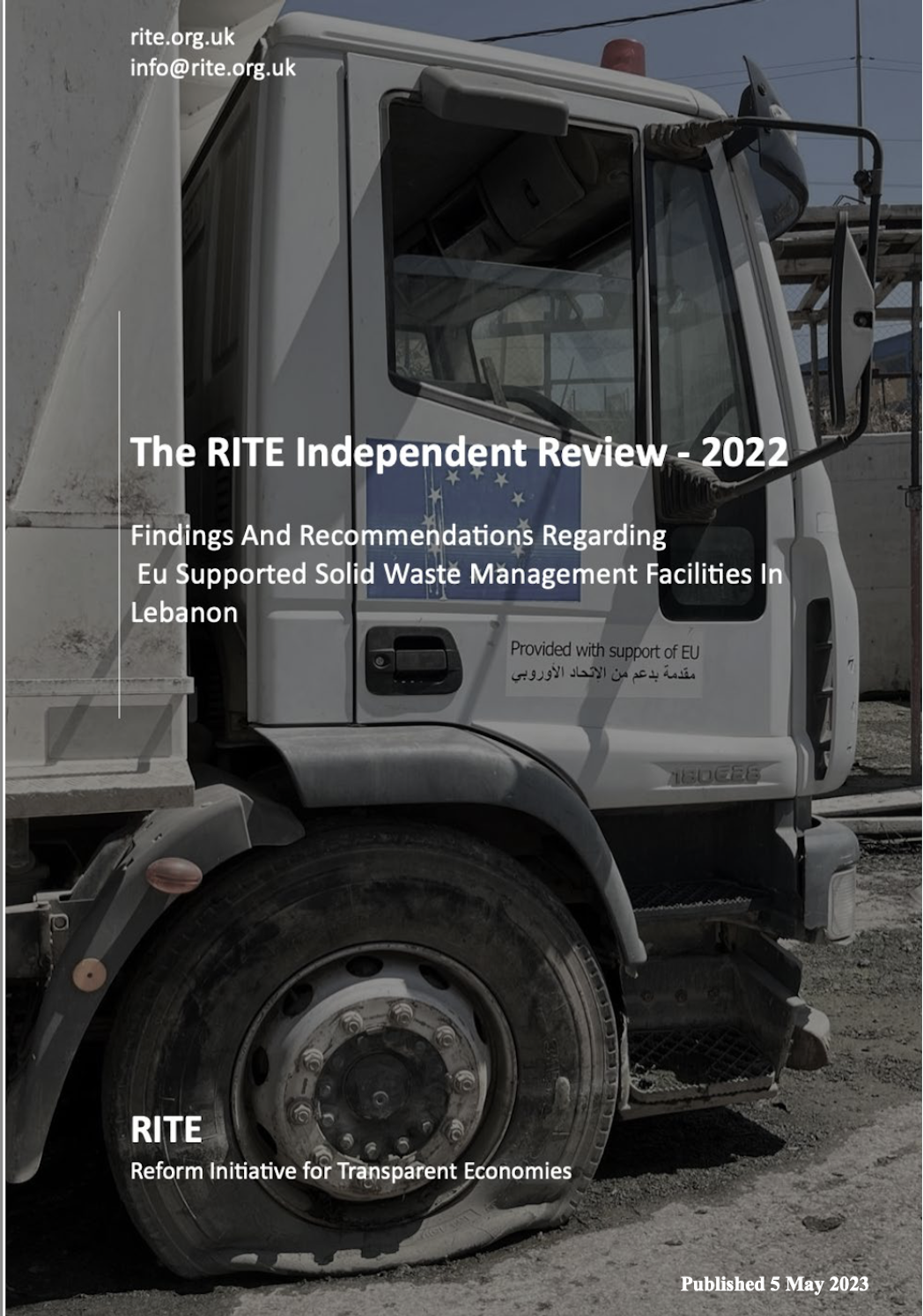
Purpose
The RITE Report seeks to identify how international development funding can help stabilise Lebanon after the collapse of its infrastructure and economy. The international community has put on hold a $11 billion pledge to shore up the country pending its implementation of IMF reforms. The pace of reforms has been very slow while the needs of Lebanese citizens and the record number of refugees that they host have become ever more urgent. Using EU supported waste management facilities as an example of wider problems, RITE independently verified whether their failings were inevitable in the Lebanese context or whether funders could make systemic changes that improve results. Its findings and recommendations support the EU Parliament Resolution calling for improvement in how Lebanon is funded.
Conclusions
EU supported solid waste facilities in Lebanon were meant to provide environmentally friendly solutions that improve waste management for residents and have cost the EU at least €30 million. All sixteen facilities under-performed and caused health and environmental risks. The EU suffered reputational damage as a result and there has been no transparency and public accountability to help alleviate that perception. The EU denies responsibility and an assessment it commissioned praised its implementing partner OMSAR. However, the RITE Report shows in detail that wastage of funds was avoidable through better management by OMSAR and greater controls by the EU. Their acts and omissions resulted in badly designed and equipped facilities and poorly supported operations. RITE found that EU assertions that there was no corruption could not be sustained without further investigations. This is because risks of fraud were not sufficiently mitigated with poor selection criteria during the bidding process, insufficient support for performance monitoring, and record keeping that is so bad that an EU commissioned report likened it to the EU ‘losing its institutional memory’. The positive aspect of these findings is that poor management can be remedied, and better mitigation controls can be put in place despite the challenges of the Lebanese context. The RITE Report makes best practice recommendations that can be adopted across funders, sectors and implementing partners and that could result in better outcomes in future.
Outcomes and Next Steps
While the EU Parliament adopted an abridged version of the RITE Recommendations in its Resolution on Lebanon of 2023, the EU Commission has sought to sidestep the issues raised in the RITE Report and claimed that its approach to funding Lebanon had since become bullet proof. RITE has researched facts that show this not to be the case and was preapring to share its findings in order to ensure better funding for Lebanon that reaches beneficiaries and protects funds. However, the war that engulfed Gaza and Lebanon since October 2023 has shifted priorities towrads considering the role of the EU in that conflict and its impact on the rules based order and democracy.
Published: 5 May 2023.